Ideas
Brand Strategy Is Not Marketing. Here's Why That Matters.
Brand Strategy Is Not Marketing. Here's Why That Matters.
Marketing tells people what's happening right now. Brand strategy tells people who you are for the long run. Most companies in sport and sports tech confuse the two, and it costs them.
Marketing Lives in the Moment
Marketing and advertising are built to respond. The Olympics are happening, so Nike runs campaigns tied to athletic greatness. The Super Bowl is approaching, so every brand with a sports adjacency buys airtime. A new league launches, so the messaging is all about the debut season, the star athletes, the opening night energy.
This is how marketing is supposed to work. It ebbs and flows based on three things: what's happening in the world, what's happening in the market, and what's happening with your product. It's reactive by design, and that's not a flaw. It's the function.
But here's the problem: if everything you communicate is tied to the moment, what happens when the moment passes? When the campaign ends, the season wraps, or the cultural event moves on, what's left?
Brand Strategy Lives in Years
Brand strategy answers a fundamentally different question. Marketing asks "what do I need to communicate right now?" Brand strategy asks "who are we over years?"
Look at how Unrivaled approached their launch. They didn't just market a new women's basketball league. They built a brand identity that signals something bigger than any single season or campaign. The visual system, the tone, the positioning all communicate a long-term vision for what women's sports can be. When the opening night hype fades, the brand still stands for something. That's the difference.
Compare that to leagues that launch with a splash of marketing, a flashy campaign, influencer posts, maybe a viral moment, but no brand foundation underneath. The first season gets attention. By the second, nobody remembers what they stand for because they never defined it.
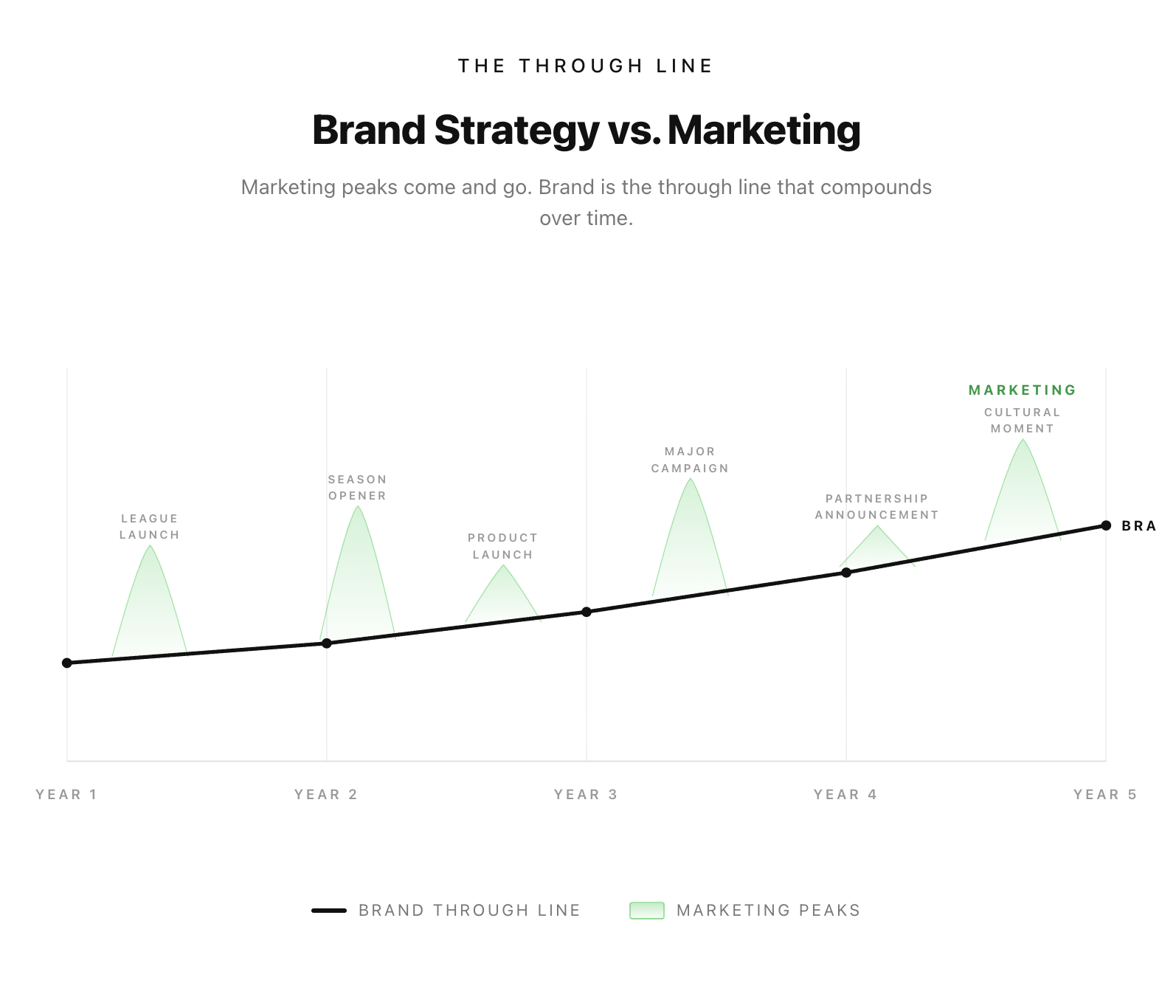
The Through Line
Think of brand strategy as a constant line running across years. It's steady, consistent, and always present. Marketing campaigns are the peaks that rise above that line at specific moments: a product launch, a season opener, a cultural event, a partnership announcement.
The brand through line is what people remember between those peaks. It's the visual identity, the voice, the values, the experience. It's what makes someone say "I know exactly what that company is about" even when there's no campaign running.
Without that through line, every marketing peak starts from zero. You're reintroducing yourself to the market every time. With it, each campaign builds on recognition and trust that already exists. The peaks get higher because the foundation keeps rising.
The Compounding Effect
Marketing delivers results in bursts. A great campaign drives traffic, sells tickets, generates downloads. But when it stops running, the results taper off.
Brand compounds. Look at Jordan Brand. Every consistent touchpoint over decades, from the Jumpman logo to the product design to the athlete partnerships, has added to an accumulating asset. Jordan Brand doesn't need to explain what it stands for in every campaign. The brand has done that work over years. Marketing just amplifies what's already there.
Now look at the sports tech space. Companies like Strava have built a brand that transcends any single feature or campaign. The identity, the community, the way it makes athletes feel like athletes, that's brand strategy compounding over time. A new competitor can launch with better features and a bigger marketing budget and still struggle to pull users away because Strava's brand equity runs deeper than any campaign.
The companies that understand this invest in brand strategy early and treat it as infrastructure. The ones that don't end up spending more on marketing to compensate for a brand that nobody recognizes or remembers.
Marketing Without Brand Is Noise
When a sports tech startup skips brand strategy and goes straight to marketing, every campaign has to do the heavy lifting of explaining who they are from the ground up. There's no shorthand. No recognition. No trust to build on. You're introducing yourself to the market over and over again.
With a strong brand foundation, marketing becomes exponentially more effective. When Unrivaled promotes a game, they don't have to re-establish credibility. The brand already carries that weight. When The Snow League announces a new event, the visual identity and brand experience have already primed the audience to pay attention. Marketing amplifies a brand. It doesn't replace one.
The Bottom Line
Marketing and advertising are essential. No league, sports tech company, or fitness brand grows without them. But they're designed to capture attention in the moment. Brand strategy is designed to hold it over years.
The companies and leagues that win long term are the ones that build the brand first and then let marketing do what it does best: amplify something that already means something.
%20(1).webp)